
Planned vs Actual Material Consumption in ERPNext Manufacturing
Track planned vs actual material consumption in ERPNext, identify BOM variance, monitor cement and raw material usage, and control hidden manufacturing costs.
Your BOM Says One Quantity. Production Used Another. Where Did the Material Go?
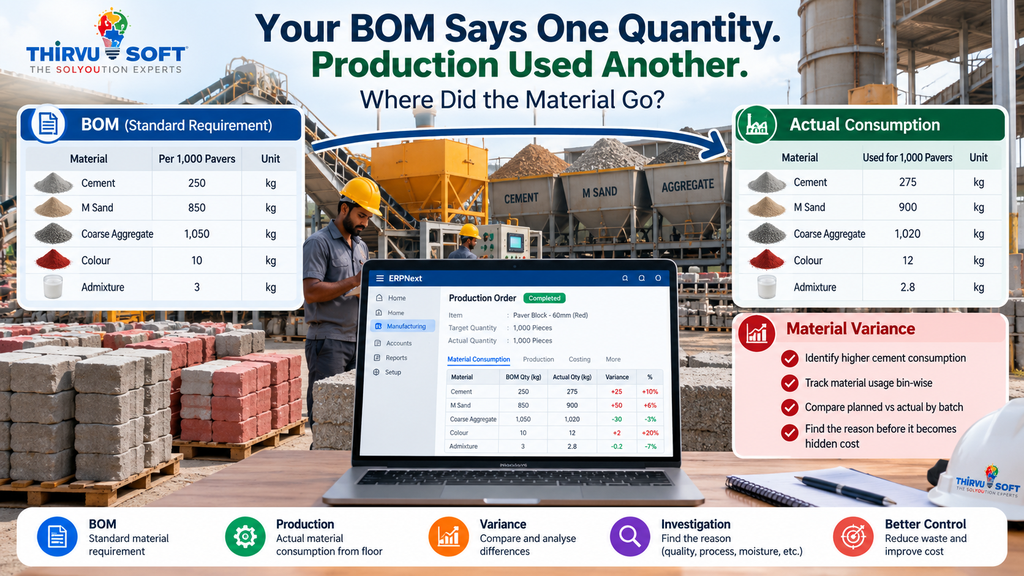
A Bill of Materials (BOM) tells a manufacturer how much material should be required for a production quantity.
But the factory may use something different.
For a paver manufacturing unit, the BOM may specify a particular quantity of cement, M-sand, aggregate, colour and admixture. During actual production, the mixer may consume more or less material.
If the ERP only records the standard BOM quantity, management sees the planned cost, not the actual manufacturing cost.
This is where manufacturing consumption variance becomes important.
A good manufacturing ERP should help the business compare what was planned with what was actually consumed.
The BOM Is the Benchmark — Not the Final Answer
A BOM provides the expected material requirement for a production batch.
For example:
| MaterialBOM QuantityActual Consumption | ||
| Cement | 250 kg | 275 kg |
| M-Sand | 850 kg | 900 kg |
| Aggregate | 1,050 kg | 1,020 kg |
| Colour | 10 kg | 12 kg |
The BOM gives the standard.
Production provides the actual.
The difference between these two values is the material consumption variance.
With ERPNext manufacturing, this comparison can become part of the production workflow instead of waiting for a month-end stock adjustment.
Why Planned vs Actual Material Consumption Matters
If the production team consumes more raw material than the BOM requires, the difference directly affects manufacturing cost.
For example, repeated excess cement consumption could indicate:
- Incorrect BOM quantity
- Moisture variation
- Mixer or process settings
- Operator practices
- Measurement differences
- Production wastage
- Changes in the actual mix
Without raw material consumption tracking, these differences can remain hidden inside overall inventory movement.
By comparing planned vs actual material consumption, management can identify where the variance starts.
Total Consumption Alone Can Hide the Problem
Suppose a factory consumes 10 tonnes of cement in a day.
That number alone does not tell management whether the consumption was correct.
The ERP should also know:
- Which product was produced
- Production quantity
- Which batch was produced
- Which machine or production line was used
- Which warehouse or bin supplied the material
- What the BOM expected
- What production actually consumed
This creates a better material consumption report.
Instead of asking:
"Why did cement stock reduce by 10 tonnes?"
management can ask:
"Which production batches consumed more cement than their standard BOM?"
That is a much more useful question.
Track Material Consumption Bin-Wise
In many manufacturing businesses, raw materials are stored in different locations or bins.
Cement may come from one location.
Aggregate from another.
Colour and admixture may come from separate storage areas.
If only one total consumption figure is recorded, the source of the variance becomes difficult to identify.
Bin-wise material consumption gives a better audit trail.
The system can preserve:
Material → Source Bin → Production Batch → Consumed Quantity → Standard Quantity → Variance
This helps stores, production and accounts work from the same information.
Make Production Data Easy to Capture
An ERP process should not create unnecessary data-entry work for production supervisors.
If a mixer or production machine already generates a detailed production sheet, the business can use a controlled Excel or CSV import instead of asking someone to manually enter every consumption line.
The workflow can be:
Production Data → Import Template → ERPNext Manufacturing Record → Actual Consumption → Variance Report
This keeps the actual production data available without making the shop floor responsible for excessive manual entry.
What Does Manufacturing Consumption Variance Tell You?
Variance becomes valuable when it is analysed consistently.
For example:
Cement:
BOM = 250 kg
Actual = 275 kg
Variance = +25 kg
M-Sand:
BOM = 850 kg
Actual = 900 kg
Variance = +50 kg
Aggregate:
BOM = 1,050 kg
Actual = 1,020 kg
Variance = -30 kg
Instead of looking only at total stock consumption, the production manager can identify which materials are repeatedly above or below standard.
This makes the production variance report useful for operational decisions.
Do Not Change the BOM Every Time Actual Usage Changes
A common mistake is to change the BOM whenever actual consumption differs.
That should not happen automatically.
The variance should first be investigated.
If the difference is caused by a temporary production issue, the BOM may still be correct.
If the same variance appears consistently across multiple production batches, the standard BOM may need review.
This creates a healthy process:
BOM Standard → Actual Consumption → Variance → Investigation → BOM Review if Required
The ERP records the difference without immediately hiding it by changing the standard.
Connect Consumption to Production and Costing
Material consumption becomes much more useful when connected to the actual production output.
For every production run, the business should be able to understand:
- Planned production quantity
- Actual production quantity
- Standard material requirement
- Actual material consumption
- Material variance
- Production batch
- Machine or cost centre
- Actual production cost
This gives management a clearer view of actual manufacturing cost.
If a paver consistently consumes more cement than its standard BOM, the additional material cost should not remain invisible.
What Management Should See
Production teams need detailed information.
Management needs exceptions.
A useful ERPNext manufacturing dashboard or report should answer:
Which production batch exceeded the BOM?
Which material has the highest variance?
Which paver product repeatedly consumes more cement?
Which production line has higher material usage?
Is the variance improving or increasing?
How much additional cost is being created?
This turns raw production data into information that management can act on.
The Connected ERP Workflow
BOM Standard
↓
Production Order
↓
Actual Material Consumption
↓
Bin / Batch / Cost Centre Tracking
↓
Planned vs Actual Comparison
↓
Manufacturing Consumption Variance
↓
Investigation & Corrective Action
↓
Accurate Production Cost
This is the difference between simply recording stock and actually using an ERP for manufacturing control.
Why ERPNext Works for This Manufacturing Workflow
ERPNext connects manufacturing, inventory, purchasing, stock and accounts within the same business system.
For a paver or concrete products manufacturer, this can create a connected flow from:
Raw Materials → BOM → Production → Material Consumption → Finished Goods → Stock → Costing
With the right customisation, production-specific information such as bin-wise consumption, mixer readings, batch details and variance reporting can be incorporated into the workflow.
This is where an experienced ERPNext implementation partner becomes important. The objective is not simply to install ERP software. The workflow should reflect how the factory actually operates.
Frequently Asked Questions
What is manufacturing consumption variance?
Manufacturing consumption variance is the difference between the material quantity expected by the BOM and the quantity actually consumed during production.
How can ERP track planned vs actual material consumption?
The ERP can retain the BOM requirement as the standard and capture actual material consumption against the production transaction. The two values can then be compared through variance reports.
Can ERPNext track cement consumption?
Yes. Cement can be maintained as a raw material and its planned requirement can be compared with actual production consumption.
Can actual mixer data be imported?
Yes. A controlled Excel or CSV import process can be designed when production data is already generated outside the ERP.
Should every consumption difference change the BOM?
No. The difference should first be investigated. A recurring and justified variance may indicate that the standard BOM requires revision.
From Monthly Stock Adjustment to Daily Production Control
The biggest benefit of manufacturing consumption variance tracking is timing.
Finding a variance during production gives the factory an opportunity to investigate it.
Finding the same variance during a month-end stock adjustment only tells you that something already happened.
With ERPNext manufacturing, the business can connect BOM standards, actual consumption, production batches, inventory and costing in one workflow.
For manufacturers looking for ERP in Coimbatore, ERPNext in Coimbatore, or ERPNext Coimbatore solutions, Thirvusoft can customise the manufacturing workflow around actual factory processes rather than forcing the business into a generic process.
Turn raw material usage into measurable production data instead of a monthly estimate.
📞 Book Your FREE ERPNext Demo Today
Call / WhatsApp: +91 63790 44767
📍 Peelamedu, Coimbatore
No comments yet. Login to start a new discussion Start a new discussion